
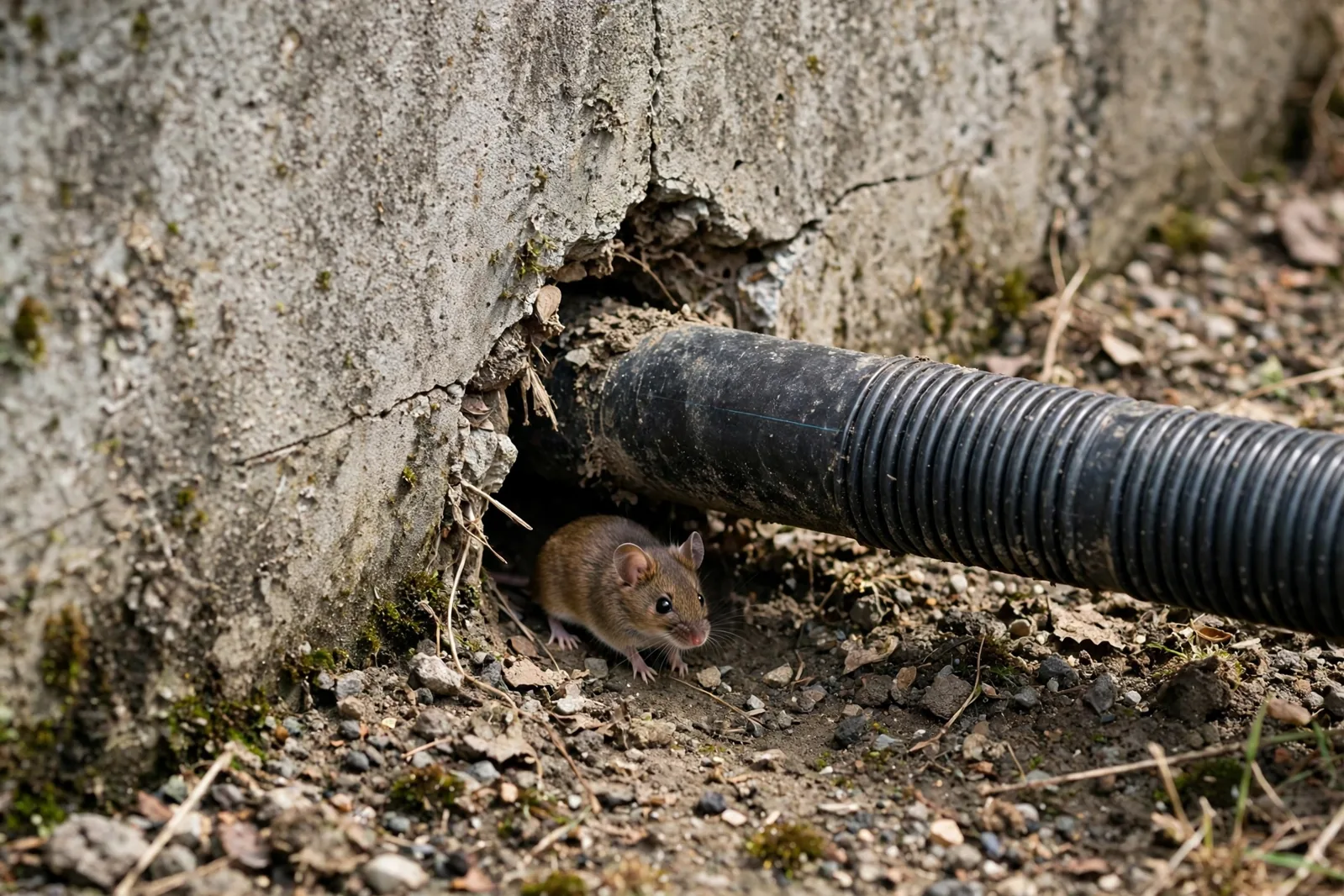
A dime-sized gap is enough
A house mouse can fit through a gap the size of a dime, and a young mouse through even less. That single fact explains most mouse problems: a home does not need a hole in the wall to let mice in. It needs a handful of small, ordinary gaps that every house develops — around pipes, wires, vents, doors, and rooflines — and mice find them.
Mice follow edges and lines as they travel, which is why they arrive along foundation walls, utility lines, and fence lines, then slip in where those lines meet the house. Once inside, they use wall voids and attic spaces as highways, which is why mice in attic and wall spaces can seem to appear in rooms far from where they entered.
The usual entry points
The most common entry points are gaps around pipes and wires where they pass through foundation and siding, vent openings for dryers and fans, rooflines where flashing and fascia have shifted, garage doors that do not seal at the corners, and doors with worn thresholds or sweeps. Basement and crawl space vents, attic vents, and the gaps where a chimney meets the roof are also regular routes.
Each of these is small on its own. Together they give mice several ways in, which is why a mice inspection maps all of them rather than fixing the first gap found. Sealing one pipe gap while a vent opening stays open just moves the problem to the next opening.
Why Olympia homes are vulnerable
Olympia's housing stock makes entry easy. Older homes in South Capitol, the Eastside, and Bigelow Highlands have settled foundations, older rooflines, and utility penetrations that have opened over decades. The wet Pacific Northwest climate keeps wood and sealants aging, so gaps that were closed years ago can reopen without anyone noticing.
Season matters too. As fall turns to winter, mice seek warm, dry shelter and food, and houses become the obvious target. Homes near greenbelts, the waterfront, and wooded lots see more pressure, because mice already live nearby and only need a gap to move in.
What to check around your home
Walk the outside of your home and look for gaps where pipes and wires enter, cracks in the foundation, vent covers that are loose or missing, garage door corners that let in light, and roofline joints that have shifted. Inside, check the attic and crawl space access points, the spaces under sinks where pipes pass through, and the corners of the garage.
Daylight is a useful test: if you can see light through a gap from inside a dark attic or crawl space, a mouse can likely use it. Mark what you find and share it with your provider — it speeds up the survey and makes sure nothing is missed.
Sealing is what makes removal last
Entry points are why mice exclusion and sealing matters as much as removal. Removing mice without sealing the gaps means new mice follow the same routes, often within the same season. The usual order is removal first, then sealing, so the mice inside are dealt with and new ones cannot replace them.
Sealing uses materials mice cannot easily chew through — metal mesh, sealant, door sweeps, and vent covers — fitted to each opening. A thorough job on an older Olympia home usually covers more points than the same job on a newer home, and that difference is normal: older homes simply have more ways in.
Garages, basements, and outbuildings
Mice often enter through the parts of a property people check least. Garage doors that do not seal at the corners, basement vents with loose covers, and sheds or workshops with gaps at the base all give mice a first foothold. From a garage or outbuilding, mice move into wall voids and then into the house itself, which is why a survey that stops at the front door misses half the routes.
Outbuildings also serve as staging areas. Mice nest in stored boxes, wood piles, and quiet corners of a shed, then use utility lines and shared walls to reach the main building. A West Bay or West Olympia property with a detached garage or shed should have those spaces surveyed along with the house, and the same sealing standard applied to them.
Seasonal timing in Olympia
Mouse pressure in Olympia follows the seasons. Activity rises in fall as nights cool and mice seek warmth, stays steady through the wet winter months when homes offer dry shelter, and eases — but does not vanish — in summer. The fall rise is the most useful moment to act: sealing done before the coldest months keeps the winter influx out, while sealing done after mice are already established has to wait for removal first.
Spring is the other useful checkpoint. Winter rains and wind can loosen vent covers, shift flashing, and open new gaps, and a spring walk around the house catches them before the next fall. Homeowners who check entry points twice a year — once in early fall and once in spring — tend to catch problems while they are still small.
Checking a new Olympia home
If you are moving into an Olympia home, a quick entry-point check before you unpack saves trouble later. Look at the gaps around pipes and wires where they enter the house, the condition of vent covers, the corners of garage doors, and the rooflines and flashing. In an older home, pay special attention to the foundation and to the attic access, where gaps are easy to miss and mice are quick to use.
Renters can do the same check and share what they find with the property owner or manager, since sealing is usually a building job rather than a tenant job. Whether you own or rent, noting the gaps early — and mentioning them when you call — helps the provider plan the survey and keeps a new home from becoming the next mouse story on the street.
The roofline route: how mice reach the attic
The roofline is the route most homeowners never look at, and mice use it constantly. Overhanging branches and vines give mice and roof rats a bridge to the roof, where they find gaps where flashing and fascia have shifted, attic vents with loose covers, and the joints where a chimney meets the roof. Once on the roof, a mouse needs only a dime-sized gap to slip into the attic, and from there wall voids carry it to every floor of the house.
Checking the roofline starts from the ground: look for branches touching the roof, vines climbing siding, vent covers that are loose or missing, and flashing joints that have shifted. Trimming branches back from the roof and keeping vines off siding removes the bridge, and sealing roofline gaps and vent openings with mesh and fitted covers closes the route itself. Attic vents deserve special attention, because a vent that looks intact from the ground may have a gap at its edge that only an attic-side check reveals.
Crawl spaces and basements: the low route
The low route runs under the house. Crawl space vents with loose or missing covers, foundation cracks opened by settling, gaps where pipes and wires pass through the foundation, and basement windows that do not seal all admit mice at ground level. Once inside a crawl space or basement, mice use joists, pipes, and wall voids to reach the kitchen and pantry above, which is why a kitchen problem sometimes starts with a crawl space gap nobody inspected.
Checking the low route means walking the foundation perimeter and looking at every vent, crack, and utility entry, plus the crawl space or basement access itself. Daylight is a useful test: if light shows through a gap from inside a dark crawl space, a mouse can likely use it. Sealing here uses mesh for vents, sealant for cracks, and fitted covers for larger openings, and it pairs with the roofline work above, because a house sealed only at the top still admits mice at the bottom.
Related services and areas
Related services: Mice Inspection, Mice Exclusion & Sealing. Also see mice control in South Capitol and mice control in Olympia, WA.